
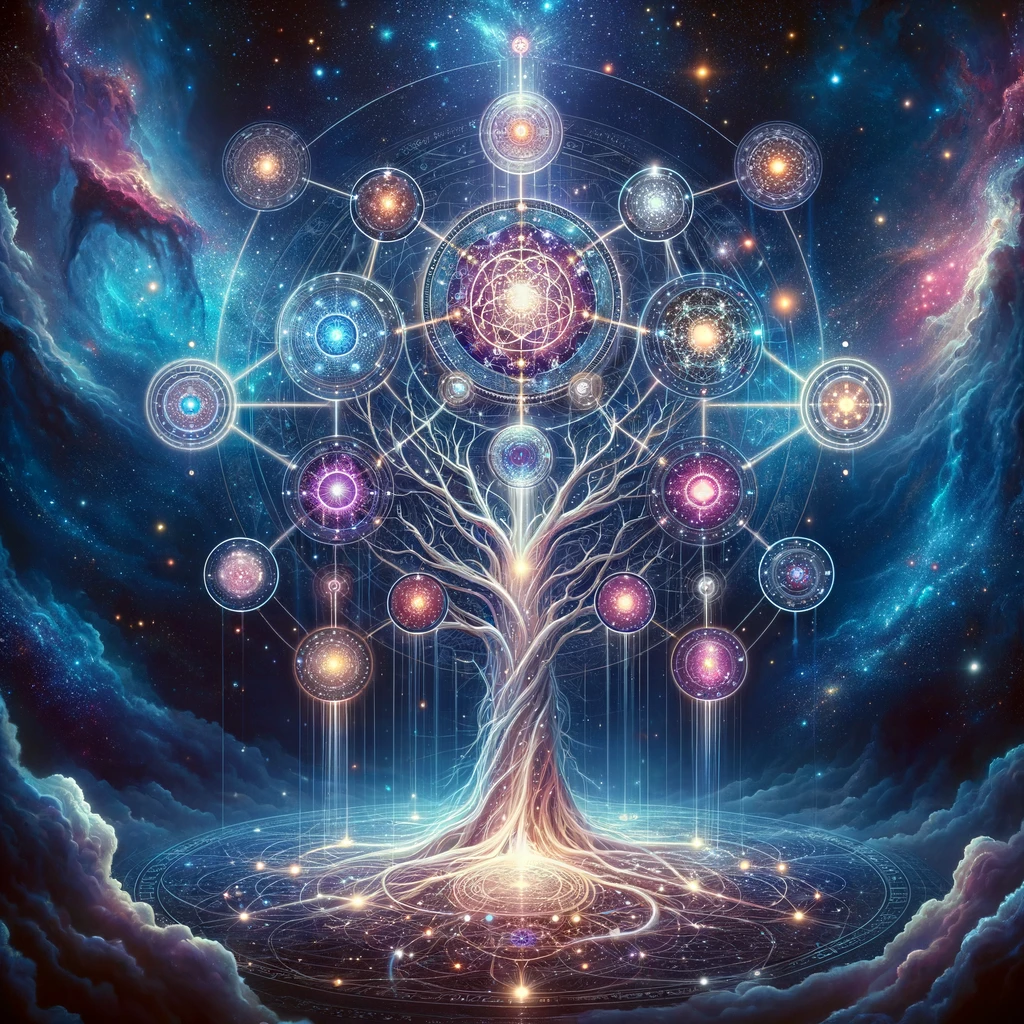
The Kabbalistic Tree of Life stands as a profound and intricate symbol within the mystical tradition of Kabbalah, offering insights into the nature of the universe, the human soul, and the divine. This mystical diagram, composed of ten interconnected spheres called sefirot and the twenty-two paths that connect them, serves as a metaphysical roadmap that guides seekers on their spiritual journey towards understanding the ineffable.
Origins and Historical Context
The roots of the Kabbalistic Tree of Life delve deep into the rich soil of Jewish mysticism, drawing nourishment from ancient Hebraic texts, including the Zohar, Sefer Yetzirah (The Book of Creation), and the Bahir (The Book of Illumination). While the exact origins of the Tree of Life are shrouded in the mists of history, it emerged as a central motif in the 12th and 13th centuries in Spain and France, where Kabbalistic thought flourished among Jewish mystics.
The Structure of the Tree of Life
The architecture of the Tree of Life is both complex and elegant. The ten sefirot represent different attributes through which the Infinite Divine Essence, known as Ein Sof, manifests and creates the world. These attributes range from Keter (Crown), symbolizing divine will and the highest form of consciousness, to Malkuth (Kingdom), representing the physical world and divine presence within it.
The sefirot are arranged in three columns or pillars: the right pillar of mercy, the left pillar of severity, and the central pillar of balance and equilibrium. This structure embodies the dynamic balance of opposing forces and qualities in the universe, echoing the principle of harmony that underpins Kabbalistic cosmology.
The Paths of Wisdom
Connecting the sefirot are twenty-two paths, each corresponding to one of the letters of the Hebrew alphabet and the major arcana of the Tarot, a connection some scholars and mystics suggest points to a deeper esoteric relationship. These paths symbolize the journeys, challenges, and transformations one may encounter on the spiritual quest, offering a multidimensional framework for understanding the complexities of human experience and the divine.
Applications and Interpretations
The Kabbalistic Tree of Life transcends its historical and cultural origins, appealing to a wide range of spiritual seekers, artists, philosophers, and scholars. Its symbols and structures are employed in various disciplines, including psychology, where it has been used to explore the depths of the human psyche, and in art and literature, where it serves as a source of inspiration and a model for creative exploration.
In practical spirituality, the Tree of Life is used as a tool for meditation, contemplation, and personal transformation. By meditating on the sefirot and their connections, practitioners aim to align themselves with the divine attributes they represent, fostering spiritual growth and insight.
Conclusion
The Kabbalistic Tree of Life remains a luminous beacon in the quest for spiritual wisdom, its mysteries beckoning to those who seek to understand the deeper truths of the cosmos and their place within it. As a living symbol, it continues to evolve, adapting to new contexts and interpretations while retaining its essence as a map of the divine landscape. In unravelling the mysteries of the Tree of Life, we embark on a journey that is both personal and universal, discovering the interconnectedness of all things and the light of the divine that shines within each of us.