
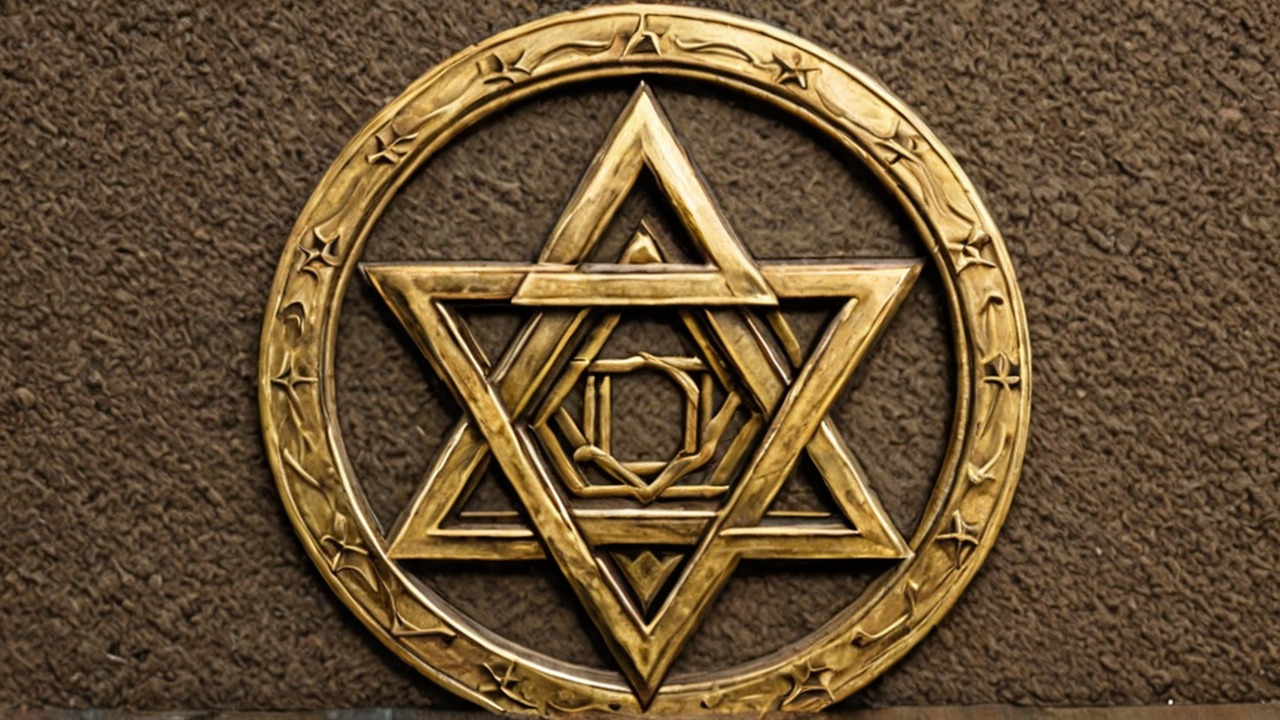
The Star of David, known in Hebrew as the “Magen David” (מָגֵן דָּוִד), which translates to “Shield of David,” is a widely recognized symbol associated with Judaism and Jewish identity. It consists of a hexagram, formed by the combination of two equilateral triangles, one pointing upwards and the other downwards, creating a six-pointed star.
Historical Origins and Development
The precise origins of the Star of David are somewhat obscure and debated among scholars. Unlike the menorah, the shofar, and other Jewish symbols, the Star of David does not have clear biblical or Talmudic references. It appears relatively late in Jewish history and has various interpretations and meanings:
- Early Uses:
- Magical and Mystical Significance: The hexagram appears in early medieval Jewish magical texts and Kabbalistic literature. It was believed to possess protective powers and was used in amulets and talismans.
- Architectural Decorations: In the 11th century, the symbol appears in Jewish contexts, such as on synagogues, manuscripts, and tombstones.
- Adoption as a Jewish Symbol:
- 14th Century: The Star of David began to be associated explicitly with Jewish communities. It was used as a decorative motif on synagogues and Jewish manuscripts.
- Prague’s Flag: In the 17th century, the Jewish community of Prague adopted it as their official symbol. This practice spread to other Jewish communities in Europe.
- Modern Usage:
- Zionism and the State of Israel: The symbol gained significant prominence with the rise of the Zionist movement in the late 19th and early 20th centuries. It was adopted as a symbol of the Jewish people and their aspirations for a national homeland. Consequently, it became the central symbol on the flag of the State of Israel in 1948.
Interpretations and Symbolism
The Star of David has been imbued with various meanings throughout Jewish history, reflecting the diversity of Jewish thought and spirituality:
- Unity and Balance: The overlapping triangles can represent the dualities of the universe—heaven and earth, male and female, spiritual and physical—coming together to form a harmonious whole.
- Divine Protection: The term “Magen David” literally means “Shield of David.” According to Jewish tradition, King David used this symbol on his shield as a sign of divine protection.
- Kabbalistic Symbolism: In Kabbalah, the Star of David is seen as a representation of the structure of the universe and the human soul, emphasizing the interconnectedness of all elements of existence.
- National and Cultural Identity: In contemporary times, the Star of David serves as a prominent symbol of Jewish identity and heritage. It is prominently displayed in synagogues, Jewish community centers, and on the flag of Israel.
The Star of David in Jewish Rituals and Art
The Star of David is widely used in Jewish rituals, art, and culture:
- Synagogues: Many synagogues feature the Star of David in their architecture and decorations, often in stained glass windows, on Torah covers, and in mosaics.
- Jewelry and Art: The symbol is commonly found in Jewish jewelry, artworks, and ceremonial objects, such as Kiddush cups and menorahs.
- Religious and Secular Emblems: It is also used as an emblem in various Jewish organizations and movements, symbolizing solidarity and connection to Jewish heritage.
Conclusion
The Star of David, or Magen David, is a profound and multifaceted symbol in Judaism, representing protection, unity, and identity. Its evolution from a mystical symbol to a central emblem of Jewish identity underscores its enduring significance in Jewish culture and history. Through its various interpretations and uses, the Star of David continues to embody the spiritual and cultural essence of the Jewish people.