
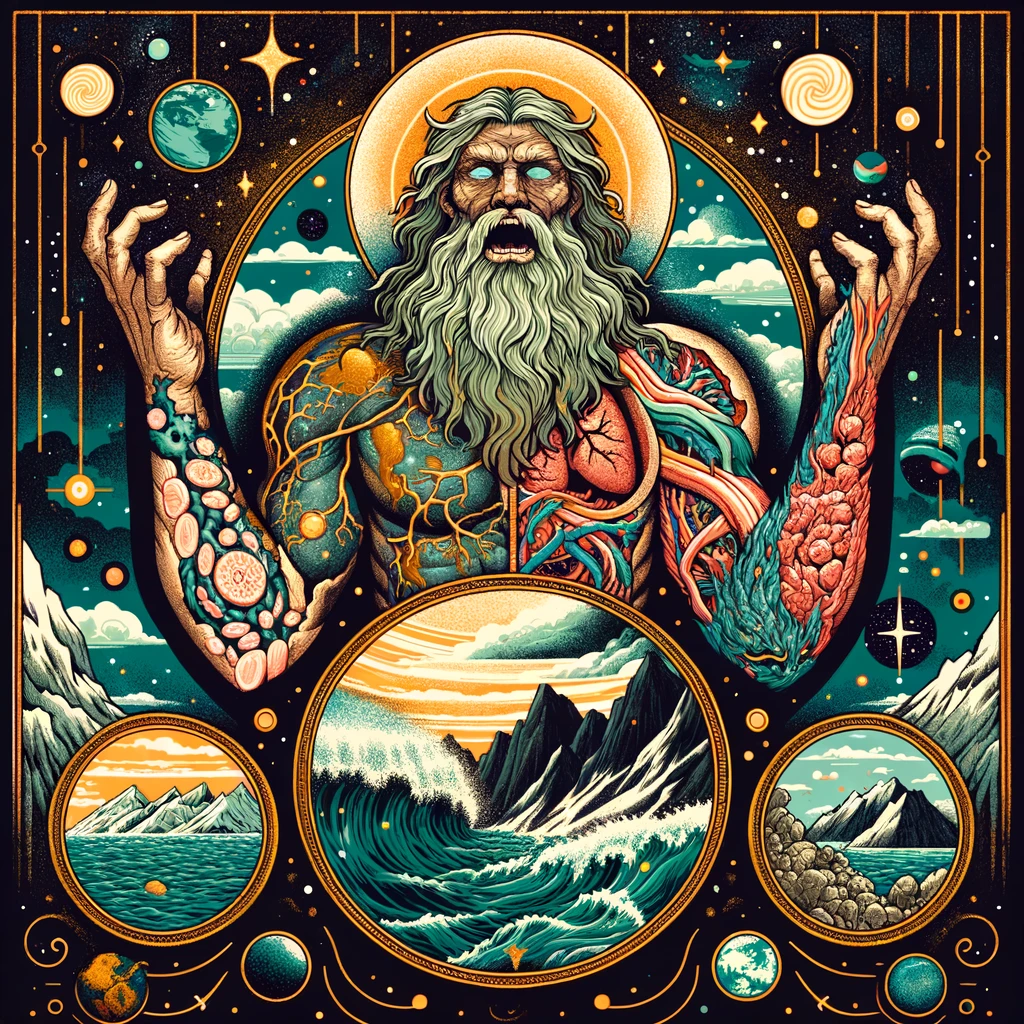
In the annals of human imagination, Norse mythology carves out a particularly visceral and corporeal view of the cosmos. Unlike other mythological systems that often begin with the intangible or the ethereal, Norse creation myths start with something strikingly physical—a giant named Ymir, whose very body becomes the substance of the world. This perspective, where the universe is a literal extension of a living entity’s flesh and blood, offers a profound reflection of the Norse understanding of life, death, and the natural world.
Ymir: The Progenitor of Life and Land
The narrative of Ymir, detailed in the Prose Edda, offers a raw and primaeval account of creation. Ymir, the first of the frost giants, emerged from the melting ice of Niflheim, met by the fiery air of Muspelheim. His existence predates the gods and the ordered cosmos, representing a formless and potent potentiality. It is from Ymir’s body, after his demise at the hands of Odin and his brothers, that the world is wrought.
A Universe Carved from Flesh
The Norse cosmos, according to myth, is literally built from Ymir’s body. His flesh turns into the earth, known as Midgard to the Vikings—home to humanity and the middle realm of Yggdrasil, the world tree. Ymir’s blood becomes the oceans and rivers, his bones the mountains, and his teeth the rocks and stones. Even the sky is part of him, crafted from his skull, and the brains become the clouds. This vivid myth speaks to a worldview that sees the divine and the physical as inseparable. The Norse cosmos is not just made by the gods but is made of a god.
The Living Landscape
This mythology imparts a sacredness to the natural world; the landscape itself is not just a creation of the divine but is divine in substance. For the Norse people, this imbued their surroundings with great meaning. The mountains they traversed, the seas they sailed, and the earth they tilled were all parts of a once-living being. This belief would have influenced their interactions with the world, fostering a relationship with nature that was both reverent and intimate.
The Echoes of Ymir in Norse Life and Ritual
The story of Ymir influenced not only the Norse understanding of the world’s origins but also their cultural practices and their approach to death and the afterlife. In Norse culture, the dead were often buried with goods, ships, and even sacrificed animals, reflecting a belief in a corporeal existence beyond death—much like Ymir’s physical transformation into the cosmos.
Norse Mythology’s Legacy
Today, the story of Ymir continues to captivate the imagination. It resonates not only with those interested in mythology but also with anyone who seeks to understand the human relationship with nature. The myth reminds us that our ancestors saw the world as alive and imbued with sacred significance, a view that can inspire us to look at our world with fresh eyes.
In modern times, when the environment is often viewed as a resource to be exploited, the Norse myth of Ymir invites us to consider a more integrated and respectful relationship with the natural world. The mountains, rivers, and skies are not just resources but reminders of our shared existence within a larger, living cosmos.
Norse mythology, with its corporeal cosmos, continues to be a profound and relevant tradition that speaks to the interconnectedness of all life. It reminds us of a time when the spiritual and the material were one, and the universe itself was a grand, divine body—a cosmos that was truly alive.
Pingback: The Giants of Lore: From Mythical Beings to Majestic Landscapes – "Bringing Your Vision to Life: Rastar13 El Bey's Digital Solutions"