
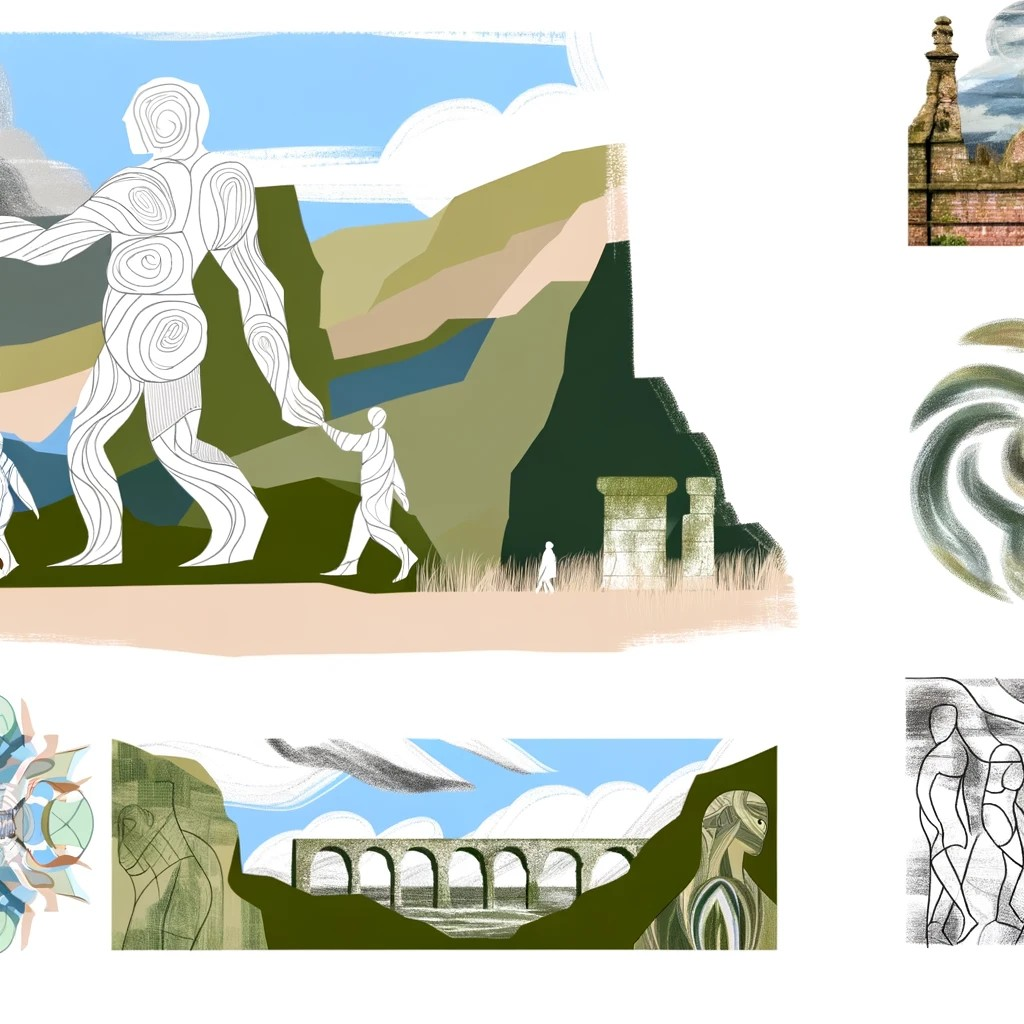
British folklore is rich with tales of giants, colossal beings whose fates are often intertwined with the landscape itself. From the rugged coasts of Cornwall to the mystical hills of the British countryside, stories abound of these titanic figures being petrified into stone, forever immortalized as mountains, hills, and rock formations. These narratives not only serve to explain the peculiarities of the British landscape but also offer a glimpse into the cultural psyche of the ancient Britons, where myth and nature were inextricably linked.
The Giant of Cerne Abbas: A Chalk Colossus
The Cerne Abbas Giant in Dorset is one of the most iconic representations of a giant in the British landscape. This enigmatic figure, carved into the chalk hillside, stands at an impressive 180 feet tall, brandishing a club, with features that suggest both virility and aggression. Local folklore varies in its interpretation of the giant’s origins, with some tales suggesting he represents the Roman god Hercules, while others believe he is a petrified real giant, defeated by the locals or by a rival giant. The figure’s purpose and origins remain a subject of debate among historians and archaeologists, but its presence in the landscape is a powerful reminder of Britain’s mythic past.
Bolster the Giant: A Cornish Legend
In Cornwall, the legend of Bolster, a giant known for his immense size and strength, is a popular tale. According to the story, Bolster fell in love with St. Agnes, a virtuous woman who, seeking to prove the giant’s love, asked him to fill a hole in the cliff with his blood. Unbeknownst to Bolster, the hole led directly to the sea, and he bled to death trying to fulfill this impossible task. The red stains on the cliffs at Chapel Porth are said to be the remnants of Bolster’s blood, and his body turned into part of the landscape, serving as a cautionary tale about the dangers of unrequited love and the folly of giants.
The Giant’s Causeway: A Geological Wonder
While not directly related to a single giant’s tale, the Giant’s Causeway in Northern Ireland is steeped in legend. According to folklore, the causeway was built by the giant Finn McCool (Fionn mac Cumhaill) as stepping stones to Scotland, to face his rival, the Scottish giant Benandonner. When Finn realizes the immense size of Benandonner, he retreats, and his wife disguises him as a baby. Upon seeing the size of the “baby,” Benandonner fears the father’s size and flees back to Scotland, destroying the causeway behind him. This story offers a mythological explanation for the causeway’s peculiar basalt column formations, illustrating the ancient need to personify and mythologize natural phenomena.
Long Meg and Her Daughters: A Stone Circle Enigma
In Cumbria, the stone circle known as Long Meg and Her Daughters is enveloped in folklore. Long Meg, a large solitary stone standing outside the circle made up of smaller stones, is said to be a petrified witch, with her daughters turned to stone for dancing on the Sabbath. Local lore warns that the stones cannot be counted twice with the same result, and if Long Meg were ever to be destroyed, the spell would be broken, releasing the witches. This tale, like many others, imbues the landscape with a sense of mystery and caution, warning against tampering with the sacred or supernatural.
The Enduring Power of Myth in the Landscape
These stories of petrified giants scattered across the British landscape serve as testament to the enduring power of folklore in shaping our understanding of natural features. They remind us of a time when the boundaries between the real and the mythical were blurred, and natural phenomena demanded supernatural explanations. In these tales, giants are not just characters; they are embodiments of the land’s spirit, its history, and its mysteries.
As we explore these ancient sites and delve into the stories that surround them, we’re invited to view the landscape through the lens of myth, where every hill, stone, and cliff tells a story of a time when giants walked the earth, leaving their mark not just in the soil, but in the very fabric of British cultural heritage.
Pingback: The Giants of Lore: From Mythical Beings to Majestic Landscapes – "Bringing Your Vision to Life: Rastar13 El Bey's Digital Solutions"