

Introduction
The concept of the multiverse is as captivating as it is complex, weaving together the threads of science fiction, theoretical physics, and deep philosophical inquiry. At its core, the multiverse proposes not just a universe, but an almost inconceivable expanse of parallel universes, each with its own laws of physics, timelines, and possibly even versions of ourselves. This notion, once relegated to the realms of speculative fiction and philosophical musings, has increasingly found a foothold in serious scientific discussions.
The allure of the multiverse lies not just in its grandeur, but in the profound questions it raises about reality, existence, and our place within the cosmic tapestry. It challenges the very notion of a singular reality, suggesting instead a cosmos teeming with endless possibilities. In this guide, we embark on an exploratory journey through the multiverse, delving into the scientific theories that support its existence and the philosophical implications that arise from contemplating infinite realms.
As we navigate the complexities of this topic, we will discover how the multiverse theory intersects with quantum mechanics, cosmic inflation, and string theory. Each of these scientific domains offers a unique lens through which to view the possibility of multiple universes, contributing to a richer understanding of the cosmos. Moreover, the multiverse concept invites us to reflect on the nature of reality, the limits of human knowledge, and the ethical dimensions of existence in a potentially infinite universe.
In embarking on this journey, we open ourselves to a world of wonder, complexity, and profound inquiry. The exploration of the multiverse is not just an academic exercise; it is a quest to expand the boundaries of our understanding and to contemplate the infinite mysteries that lie beyond our current horizons.
Unveiling the Multiverse: Scientific Theories

The scientific pursuit to understand the universe has led to groundbreaking theories that not only expand our knowledge of the cosmos but also introduce the staggering possibility of multiple universes. This section delves into the core scientific theories that underpin the multiverse concept.
Quantum Mechanics and the Many-Worlds Interpretation
Quantum mechanics, a fundamental theory in physics, describes the peculiar behavior of particles at the smallest scales. At the heart of quantum mechanics lies the principle of superposition, where particles can exist in multiple states simultaneously until observed. This principle leads to the Many-Worlds Interpretation (MWI), proposed by physicist Hugh Everett in 1957. MWI suggests that all possible outcomes of quantum measurements indeed occur, but each in a separate, parallel universe. This interpretation eliminates the concept of a single, unique outcome, proposing instead a branching series of diverging universes for each quantum event.
Cosmic Inflation and Bubble Universes
The theory of cosmic inflation, introduced by Alan Guth in the early 1980s, provides another framework for the existence of the multiverse. It posits that the universe underwent a rapid expansion just after the Big Bang, faster than the speed of light. This expansion could have led to the creation of ‘bubble universes’ within an ever-inflating cosmos. Each bubble could have different physical constants and laws, essentially creating a vast multiverse of isolated universes.
String Theory and the Landscape of Universes
String theory, a candidate for the theory of everything, posits that the fundamental constituents of the universe are not point-like particles but rather tiny, vibrating strings. These strings can exist in multiple configurations, each determining the properties of particles and forces in a universe. The “landscape” of string theory is vast, suggesting a staggering number of possible universes, each with its own unique set of physical laws and constants, within the multiverse.
These scientific theories, each profound in its own right, collectively provide a framework for contemplating the existence of the multiverse. They push the boundaries of our understanding and invite us to consider the cosmos not as a solitary realm but as a spectacular array of universes, each with its own story.
Beyond Science: Philosophical Implications
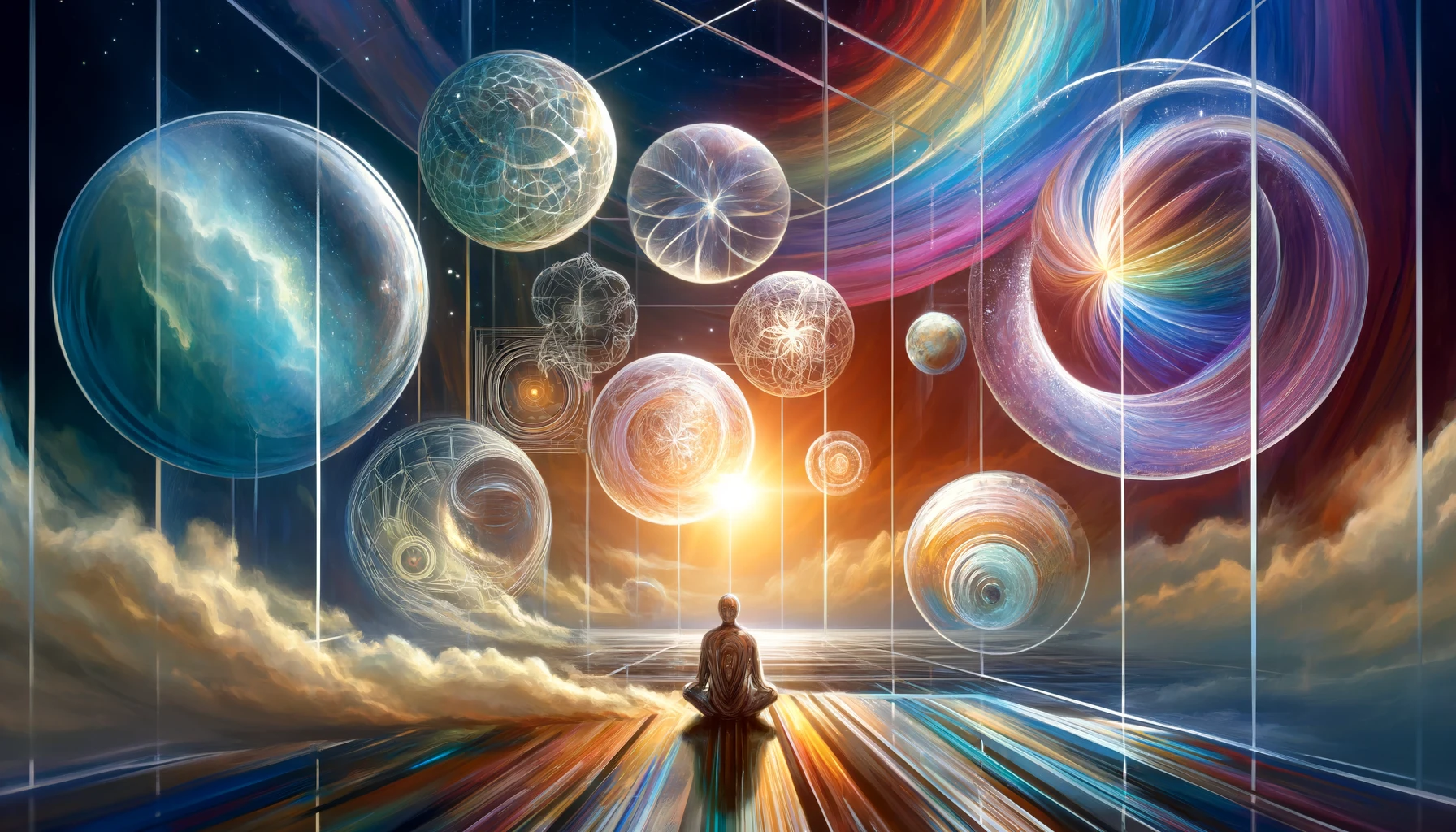
The multiverse theory doesn’t just stretch the boundaries of science; it also propels us into profound philosophical territories. By contemplating the existence of countless universes parallel to our own, we’re invited to reconsider some of our most fundamental notions about reality, ethics, and our place in the cosmos.
The Notion of Reality and Existence in Multiple Universes
The idea of multiple universes prompts a reevaluation of what we consider to be ‘real.’ If countless other universes exist, each with its own version of reality, what does that say about our own universe’s uniqueness and significance? This question touches on age-old philosophical debates about the nature of existence and our understanding of the ‘real’ world.
Ethical and Moral Considerations in an Infinite Cosmos
The potential existence of infinite universes also raises unique ethical and moral questions. For instance, if every possible scenario plays out in some universe, does that diminish the importance of our choices in this universe? Philosophers ponder whether the multiverse theory could lead to a sense of moral relativism or nihilism, challenging us to find meaning and morality in a potentially boundless cosmos.
The Impact on Human Understanding and Perception
Finally, the multiverse concept challenges our cognitive frameworks. It asks us to envision a reality far beyond the human scale, pushing the limits of our imagination and understanding. This philosophical journey can be both humbling and exhilarating, as it confronts us with the vast unknown and the infinite potential of the cosmos.
As we grapple with these philosophical implications, we gain not only a deeper insight into the nature of the universe but also a richer appreciation for the complexity of human thought and inquiry. The multiverse theory serves as a bridge between the empirical realm of science and the speculative domain of philosophy, inviting us to explore the profound questions that lie at the heart of our quest for knowledge.
The Human Connection: Implications for Our Daily Lives

While the multiverse theory may seem a topic reserved for physicists and philosophers, its implications ripple through our everyday lives, influencing our perceptions, beliefs, and even our culture. This section explores how the vastness of the multiverse might impact our daily experiences and societal norms.
Psychological Effects of Multiverse Theories
The idea that countless other versions of ourselves might exist in parallel universes can have profound psychological effects. It can alter our sense of self, challenge our perceptions of uniqueness and individuality, and even affect our decisions and ethical considerations. The multiverse theory invites us to contemplate the infinite paths our lives could take, which can be both exhilarating and daunting.
Cultural and Societal Impacts of Accepting Multiple Realities
The acceptance of the multiverse theory can also shift cultural narratives and societal norms. Stories, myths, and religious beliefs have often explored themes of alternate realities and parallel worlds. The scientific legitimization of the multiverse could further these explorations, impacting everything from art and literature to philosophy and spirituality, fostering a culture more attuned to the complexities and mysteries of the cosmos.
As we conclude our journey through the multiverse, we find that this cosmic concept not only expands our understanding of the universe but also offers a unique lens through which to view our own lives. It challenges us to think bigger, question deeper, and embrace the vast unknowns that lie both within us and beyond the stars.
Conclusion

As we draw our exploration of the multiverse to a close, we find ourselves at the threshold of an ever-expanding cosmos, one that stretches far beyond the confines of our current understanding and imagination. The journey through the scientific underpinnings, philosophical implications, and the human connection to the multiverse concept has not only illuminated the vastness of the cosmos but also reflected the depth of human curiosity and our insatiable quest for knowledge.
The multiverse theory, with its myriad universes and endless possibilities, invites us to reconsider the very nature of reality, challenging us to think deeply about questions of existence, identity, and our place in the infinite expanse. It blurs the lines between science and philosophy, merging empirical evidence with existential inquiry, and in doing so, enriches both disciplines.
Moreover, the notion of the multiverse resonates beyond academic circles, influencing culture, spirituality, and our everyday lives. It encourages us to embrace the complexities of the universe, to find comfort in the unknown, and to remain open to the myriad possibilities that lie ahead.
As we continue to gaze into the night sky, let the concept of the multiverse remind us of the boundless wonders of the cosmos and the shared human endeavour to understand the mysteries that lie beyond our reach. In the grand tapestry of the universe, our quest for knowledge is but a single thread, woven with the hopes and dreams of countless explorers who have come before us and those who will follow.
The exploration of the multiverse is a testament to human imagination and resilience, a beacon of hope in our unending journey to understand the cosmos and our place within it. As we move forward, let us carry with us the sense of wonder and curiosity that the multiverse inspires, for in the pursuit of the unknown lies the true essence of discovery