

Introduction
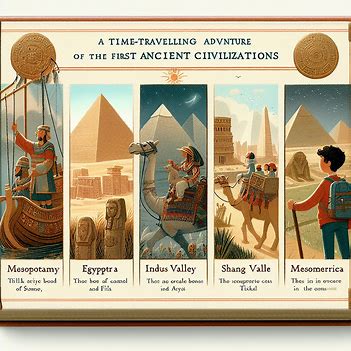
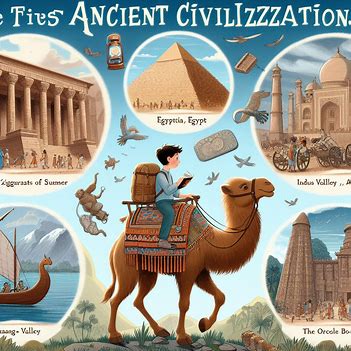
Human civilization has a rich tapestry woven through the annals of time, with each era leaving its indelible mark on the pages of history. Among the most intriguing epochs are the first five ancient civilizations, each laying the foundation for subsequent societies to flourish and evolve. Let us embark on a journey through Mesopotamia, Ancient Egypt, the Indus Valley, Ancient China, and Ancient Greece, unraveling the mysteries and marvels that define their legacies.
1. Mesopotamia: Cradle of Civilization
Sumerians: Builders of the first cities
In the fertile crescent between the Tigris and Euphrates rivers, the Sumerians erected the world’s first known cities. Their innovative urban planning, with intricate canal systems and ziggurats, laid the groundwork for future urban centers.
Hammurabi’s Code: The earliest known written legal code
Under the rule of Hammurabi, the Babylonian Empire flourished, and with it came the codification of laws. Hammurabi’s Code, carved into a stele, established a system of justice that influenced legal systems for centuries to come.
2. Ancient Egypt: Land of Pharaohs and Pyramids

The Nile River: Lifeline of Egypt
Stretching from the heart of Africa to the Mediterranean Sea, the Nile River sustained the ancient Egyptians with its annual floods, providing fertile soil for agriculture and facilitating trade and transportation.
Pyramids: Architectural wonders of the world
The towering pyramids of Giza stand as enduring testaments to ancient Egypt’s architectural prowess. Built as royal tombs, these monumental structures reflect the Egyptian belief in the afterlife and the divine status of their pharaohs.
3. Indus Valley Civilization: Mysteries of the Harappans
Urban planning: Advanced city layouts
The cities of Mohenjo-Daro and Harappa, built by the Harappans, boasted sophisticated urban planning, with well-organized streets, drainage systems, and multi-story houses, indicating a highly structured society.
Indus script: An undeciphered writing system
Despite the wealth of archaeological findings from the Indus Valley Civilization, the Harappan script remains a mystery, eluding decipherment and leaving scholars intrigued by the secrets it may hold.
4. Ancient China: Dynasties and the Great Wall
Xia Dynasty: China’s first dynasty
According to Chinese legend, the Xia Dynasty marked the beginning of China’s dynastic history, with Emperor Yu credited for taming floods and establishing order, laying the foundation for subsequent dynasties.
The Great Wall: A monumental feat of engineering
Stretching over 13,000 miles, the Great Wall of China stands as a testament to ancient Chinese ingenuity and determination. Built to defend against invasions from nomadic tribes, it remains one of the most impressive architectural achievements in history.
5. Ancient Greece: Birthplace of democracy and philosophy
City-states: Athens and Sparta
Ancient Greece was characterized by its city-states, each with its own government, culture, and identity. Athens, the cradle of democracy, and Sparta, renowned for its military prowess, embodied contrasting ideologies.
Philosophy: Socrates, Plato, and Aristotle
The philosophical traditions of ancient Greece laid the groundwork for Western thought. Visionaries like Socrates, Plato, and Aristotle explored fundamental questions about ethics, politics, and the nature of reality, leaving a profound intellectual legacy.
Conclusion
The journey through the first five ancient civilizations offers a glimpse into the ingenuity, creativity, and resilience of humanity’s early ancestors. From the towering ziggurats of Mesopotamia to the philosophical debates of ancient Greece, each civilization forged its own path, leaving an enduring imprint on the pages of history.
FAQs (Frequently Asked Questions)
- Were the ancient civilizations interconnected?
- How did geography influence the development of these civilizations?
- What led to the decline of each ancient civilization?
- Is there evidence of trade and cultural exchange between these civilizations?
- What lessons can we learn from studying ancient civilizations?